
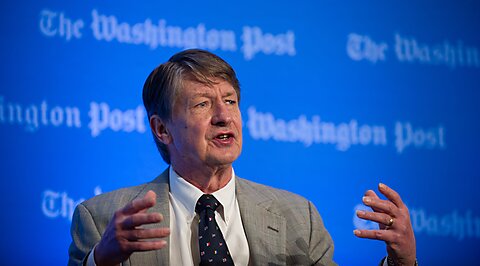

“Does ‘Pursuit of Happiness’ mean I can drink before noon? These are all important questions.” – P.J. O’Rourke (1947–2022)
With America’s intense level of partisanship showing no signs of abating, I recently reread P. J. O’Rourke’s final book: A Cry from the Far Middle: Dispatches from a Divided Land (2020). It offers a laugh-filled yet serious meditation on America’s political polarization and how civility might help restore liberty in this divided republic. So I’ve been thinking a lot about P. J. of late, whom The Wall Street Journal once dubbed “the funniest writer in America.”
P. J. was a longtime libertarian and former H. L. Mencken Research Fellow at the Cato Institute, so I was lucky enough to get to know him when I joined Cato as President & CEO. In addition to his tremendous career as a reporter and satirist, P. J. was a kind and respectful person who modeled the civility he recommended in his last book. In our conversations, P. J.’s wit was matched only by his generosity of spirit—he could skewer foolishness without ever being cruel, and he treated everyone with genuine warmth and interest. He understood that defending liberty didn’t require making enemies and that humor could be a more effective teacher than indignation.
Over his globe-trotting career, P. J. wrote 21 books. Three of these were New York Times bestsellers, with two reaching No. 1. In the preface of A Cry from the Far Middle, aptly entitled a “Manifesto for Extreme Moderation,” P. J. proposed a movement we could use today: “We need a political system that isn’t so darn sure of itself. It’s time for the rise of the extreme moderate. Power to the far-middle! Let’s bring the Wishy and the Washy back together, along with the Namby and the Pamby, and the Milque and the Toast.”
P. J. was never milquetoast, even when calling for moderation. His writing, from the 1960s onward, was sharp, irreverent, and unmistakably his own. You knew exactly where he stood—and what he found ridiculous—but he delivered his views with enough humor and self-deprecation to make readers on the right, left, center—and, indeed, the extreme center—laugh rather than seethe. That’s precisely why his work remains a model for how satire can help us talk to one another, not at one another.
This spirit resonates deeply with Cato’s Statement of Principles, which affirms the moral worth and dignity of every individual and calls for “respectful and civil discourse with and from others.” As I wrote in the Fall 2025 issue of Free Society, engaging constructively with opposing viewpoints isn’t optional—it’s essential to that free society to which we aspire. P. J. lived that ideal, often proving that humor, honesty, and civility can coexist even in the fiercest debates. After all, Reagan and Gorbachev managed it, as did Justices Scalia and Ginsburg.
Today, in an age of tribalism, outrage, and envy, P. J.’s approach offers a desperately needed antidote. His was the laughter that deflated pomposity, not the kind that sneered. His satire invited thought rather than deepened division.
P. J.’s journey—from a hippie Marxist writing for underground papers in the 1960s to National Lampoon editor-in-chief, to Rolling Stone’s foreign-affairs desk chief, to self-described “pants-down Republican”—was a uniquely American evolution. Over the years, he contributed to Car & Driver, The Atlantic, Playboy, The Weekly Standard, Vanity Fair, Esquire, Forbes FYI, and even House & Garden. His voice—a cross between H. L. Mencken, Mark Twain, and Hunter S. Thompson—captured the contradictions and absurdities of modern life better than almost anyone.
P.J. brought his wit to many Cato events over the years, prior to his passing from cancer in 2022. Reflecting on P. J.’s death, Distinguished Senior Fellow David Boaz wrote, “Yes, P. J. was one of the funniest writers around.… But what people often miss when they talk about his humor is what a good reporter and what an insightful analyst he was. Parliament of Whores is a very funny book, but it’s also a very perceptive analysis of politics in a modern mixed‐economy democracy. … We’re going to miss P. J. terribly. But as long as we have his books and his other writings, we will remember how much he made us laugh and how much we learned along the way.”
That legacy deserves preservation—and thankfully, there’s an effort underway to do that. Award-winning editor Terry McDonell is leading a project to collect and archive P. J.’s papers at the Dolph Briscoe Center for American History at the University of Texas at Austin. McDonell, himself a novelist, poet, and member of the American Society of Magazine Editors’ Hall of Fame, was friends with P.J. since the 1970s. Their camaraderie shaped some of the sharpest and funniest journalism of their generation.
The Briscoe Center is a fitting home for P. J.’s legacy. It houses one of the most comprehensive collections of media history in existence, including the papers of Walter Cronkite, Morley Safer, Andy Rooney, Molly Ivins, Dominick Dunne, and the aforementioned Terry McDonell. Adding P. J.’s archives will ensure future generations can study how his humor shaped American political and cultural discourse. Those interested in supporting this project can visit the Briscoe Center’s dedicated website to contribute to the project.
So raise a glass—perhaps even before noon—to P. J. O’Rourke. Celebrate a writer who proved that laughter and liberty belong together.